What Is Return on Equity in Multifamily Real Estate?
Most multifamily owners know their rental income, occupancy, and mortgage payment.
Far fewer know their current Return on Equity (ROE).
And in today’s commercial real estate environment — with rising property values, changing interest rates, and compressed returns — that may be the most important number to understand.
Request a Complimentary ROE Analysis
I work with apartment owners across California’s Central Valley every week, and the same pattern comes up repeatedly:
The property is performing well.
The loan balance has steadily declined.
The asset has appreciated over time.
On paper, everything looks healthy.
But when I ask:
“What return are you earning on the equity currently tied up in the property?”
Most owners are not sure how to answer.
Not because they are poor operators. Because ROE is rarely discussed — even though it is one of the clearest indicators of whether your equity is still working efficiently.
What is Return on Equity (ROE) in Real Estate?
Return on Equity (ROE) measures the annual cash flow your property produces relative to the equity you currently have invested in it — not the equity you put in years ago, but what’s locked in today.
It answers a question every owner should be able to answer in one sentence: “If I sold this property today and reinvested the proceeds, would I do better, worse, or about the same?”
Unlike Cap Rate, which is a market metric tied to the property, ROE is a personal metric tied to you — your equity, your basis, your goals. Two owners can hold identical buildings on the same street with wildly different ROEs depending on:
-
- When they purchased the property
- How much debt remains
- How much the property has appreciated
- Their current cash flow
- Their long-term investment goals
That is why ROE becomes especially important for long-term multifamily owners.
The Return on Equity Formula
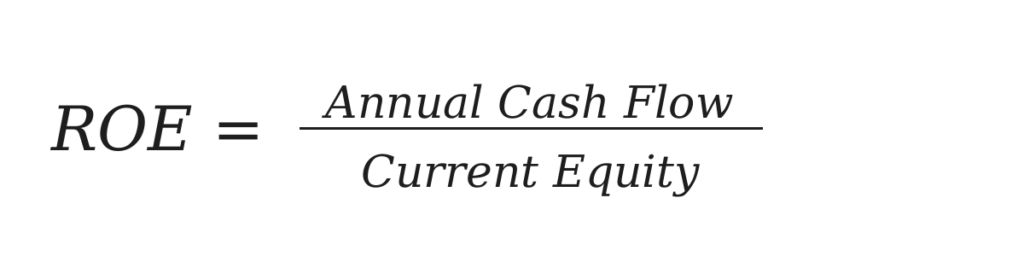
Current Equity = today’s estimated market value minus the remaining loan balance and estimated closing costs.
Annual Cash Flow = Net Operating Income minus debt service, capital reserves, and any non-recurring items.
The math itself is relatively straightforward.
The strategy behind the number is where the conversation becomes important.
As values rise and loans pay down, equity grows — but the returns on that equity often don’t keep pace. Here’s a quick example of what that looks like:
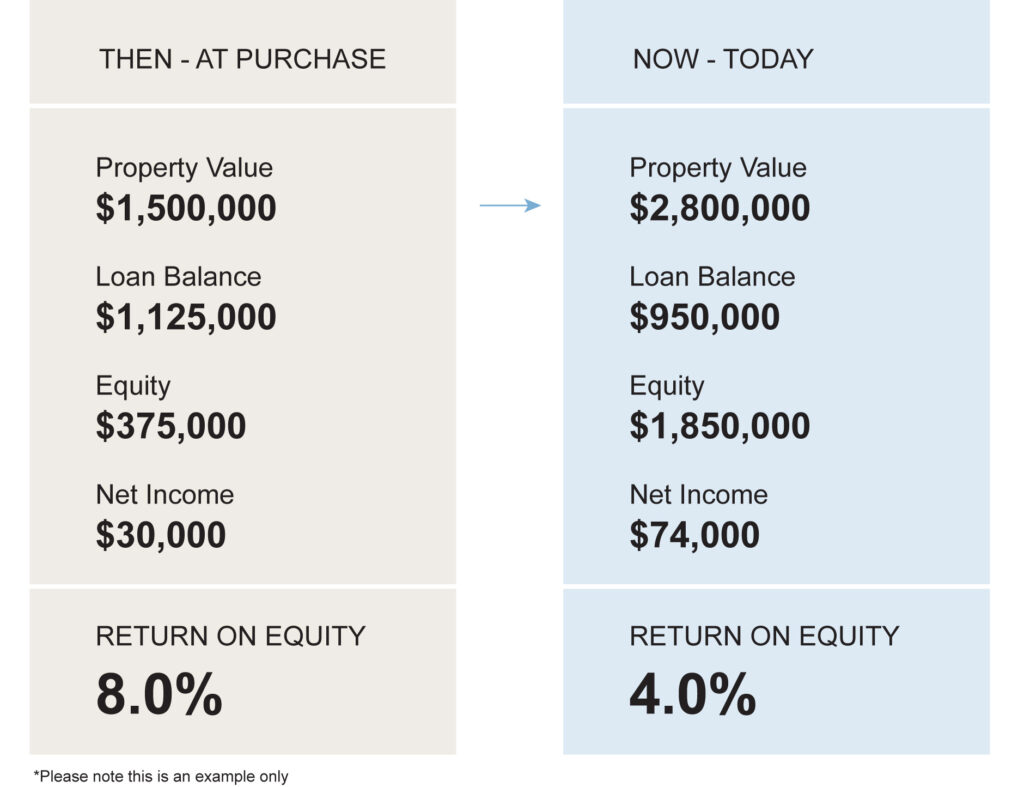
Use our tool to calculate your Return on Equity in seconds.
Why ROE Matters for Multifamily Owners
Over time, many apartment owners experience significant appreciation while rents and cash flow grow more slowly.
As that happens, equity builds inside the property — sometimes faster than the property’s income performance.
That can create a situation where:
-
- Your property appears successful
- Your net worth increases
- But your actual return on equity steadily declines
This is common throughout the Central Valley, especially with long-term ownership groups and legacy multifamily assets.
In many cases, owners are sitting on substantial equity while earning relatively modest returns on that equity position.
That does not automatically mean you should sell.
But it usually means the property deserves a closer review.
What Is Considered a Good Return on Equity?
There is no universal “perfect” ROE.
The right number depends on:
-
- Your risk tolerance
- Tax position
- Debt structure
- Estate planning considerations
- Management intensity
- Alternative investment opportunities
That said, many stabilized multifamily assets generally fall into ranges like these:
Below ~4% ROE
Equity may be underperforming.
This often happens when appreciation has significantly outpaced income growth. Owners may benefit from evaluating refinance opportunities, operational improvements, or a potential 1031 exchange strategy.
~4%–8% ROE
Generally stable and reasonable.
Many long-term apartment owners fall within this range. The focus becomes optimizing debt, operations, tax strategy, and long-term planning.
Above ~8% ROE
Strong relative performance.
At this level, the conversation often shifts toward protecting the asset’s position, maintaining occupancy, and preserving long-term cash flow stability.
When to run the number
ROE drifts. Markets move, loan balances drop, life changes. The number you ran two years ago has almost certainly changed. There’s no single right cadence, but four moments are worth flagging:
Every 18–24 months
A regular cadence catches drift before it compounds into a missed window.
Before a refinance
Pulling cash out changes both sides of the equation. Model it before you sign anything.
At major life events
Retirement, partnership changes, estate planning, divorce — each one shifts what “good ROE” means for you.
At market inflection points
Significant rate moves, cap rate compression, or a comparable sale nearby — any of these can change the picture quickly.
Complimentary Multifamily ROE Analysis
At Visintainer Group, we work with multifamily owners throughout California’s Central Valley to evaluate how their equity is performing in today’s market.
If you would like a complimentary Return on Equity analysis for your apartment property, we can help review:
-
- Estimated market value
- Current loan structure
- Cash flow performance
- Equity position
- Reinvestment or hold strategies
The analysis is confidential, straightforward, and designed to help owners make more informed long-term decisions.
Request a Complimentary ROE Analysis
Learn more about Return on Equity.
Blake Blackburn
Multifamily Investment Advisor
Agent DRE# 02171472
Continue Reading More Updates from Blake:
- Central Valley Multifamily Market Update – Q1 2026
- VIDEO: Multifamily Loan Maturity: What to do when your rate jumps
- VIDEO: Central Valley Multifamily Market Update: Income Stability & Investment Trends
- VIDEO: Central Valley Multifamily Market Update – Q2 2025
- Multi-Family Insights: One Big Beautiful Bill
- Multi-Family Insights: New Apartment Supply: A Five-Year Surge
Learn more about our: