Central Valley Multifamily Market Update: Cap Rates Rise as Investor Activity Remains Strong in 2026
The Central Valley multifamily market continues to evolve as investors adjust to a higher interest rate environment. While borrowing costs remain elevated compared to the historically low-rate period of 2020–2022, the market has found something investors value just as much as low rates: stability.
A review of first-quarter multifamily transaction activity across the Central Valley highlights how investor behavior has shifted over the past several years and provides insight into where the apartment investment market may be headed next. The data shows a market that is normalizing—not retreating.
Multifamily Transaction Activity Remains Elevated
First-quarter transaction volume has remained significantly higher than the levels experienced during the uncertainty of 2023.
Central Valley First-Quarter Multifamily Transactions
- 2023: 9 sales
- 2024: 16 sales
- 2025: 18 sales
- 2026: 15 sales
Although transaction volume softened slightly in the first quarter of 2026 compared to the previous two years, activity remains well above 2023 levels. In fact, the market has averaged approximately 81% more first-quarter transactions over the past three years than it did during the height of interest rate uncertainty.
Interest Rate Stability Has Restored Investor Confidence
One of the primary drivers behind the increase in multifamily investment activity has been the stabilization of interest rates.
The rapid rate increases of 2023 created significant uncertainty throughout commercial real estate markets. Many investors paused acquisitions while evaluating how higher borrowing costs would impact property values, cash flow, and long-term investment returns.
Today, while rates remain elevated, they have largely traded within a narrower range. This increased predictability has allowed investors to underwrite opportunities more confidently and re-enter the market. The result has been stronger transaction activity and a healthier investment environment than many anticipated several years ago.
Cap Rates Continue to Adjust
Perhaps the most notable market shift has been the movement in multifamily cap rates.
The average Central Valley multifamily cap rate reached 6.55% in the first quarter of 2026, compared to:
- 5.62% in Q1 2023
- 6.01% in Q1 2024
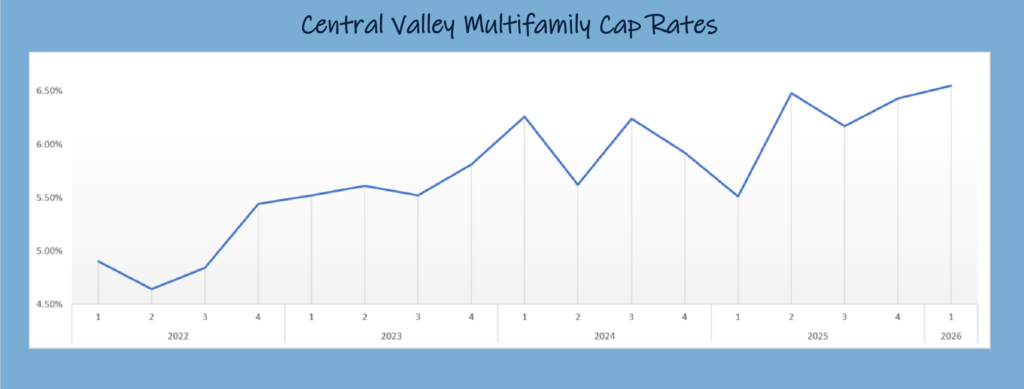
Higher cap rates reflect the returns investors now require in today’s lending environment. Buyers are balancing increased financing costs alongside rising operating expenses and changing rent growth expectations. As a result, pricing across many multifamily assets has adjusted accordingly.
For owners, understanding how current cap rates compare to historical trends is critical when evaluating refinancing opportunities, potential dispositions, or long-term hold strategies.
Many of these changes can be traced back to movements in the broader interest rate market. As we discussed in our article, “How Higher Treasury Yields Affect Central Valley Multifamily Owners,” Treasury yields serve as the foundation for commercial real estate lending and can directly impact borrowing costs, refinancing opportunities, and property values.
What This Means for Central Valley Apartment Owners
The Central Valley multifamily market remains active, but success today requires a more strategic approach than during the ultra-low interest rate years.
Owners should pay close attention to:
- Current cap rate trends
- Loan maturity timelines
- Refinancing opportunities
- Property operating expenses
- Market rent growth
- Buyer demand within their submarket
While pricing dynamics have shifted, investor demand for well-located multifamily assets throughout Fresno, Visalia, Clovis, Madera, Merced, and surrounding Central Valley communities remains strong.
Looking Ahead
The first quarter of 2026 suggests a multifamily market that is adapting to a new normal. Transaction volume remains healthy, investor confidence has improved, and cap rates continue to reflect the realities of today’s financing environment.
For owners considering a sale, refinance, or portfolio review, understanding how these market trends impact property value is more important than ever.
If you’d like to discuss how current multifamily market conditions may affect your investment strategy, contact Blake Blackburn for a confidential portfolio review and market analysis.
Blake Blackburn
Multifamily Investment Advisor
Agent DRE# 02171472
Continue Reading More Updates from Blake:
- What is Return on Equity in Multifamily Real Estate?
- Central Valley Multifamily Market Update – Q1 2026
- VIDEO: Multifamily Loan Maturity: What to do when your rate jumps
- VIDEO: Central Valley Multifamily Market Update: Income Stability & Investment Trends
Learn more about our: